Showing posts with label plastic junk. Show all posts

Saturday, May 25, 2013

Veronica Grey talks about "Ocean Plastics' in Green Living Magazine


Plastics Invading Our Oceans

BY CHERYL HURD
Surfing conjures up images of free spirits, at one with the ocean, without a care in the world. But for Surf Lady Veronica Grey, it is the world she so desperately cares about.

About a year ago, the waves called to Grey. Although the California actress and filmmaker did not know at the time, the message they carried for her, that day would change her life. She lay belly down on her surfboard and paddled her way to depths beyond the breaking waves, where she would wait for the perfect ride. On this day, the rhythm of stroke meeting ocean was interrupted. She plunged her hand into the water, and then recoiled. Between her fingers dripped a slimy substance.


“I remember the first time I felt it. I was paddling out on my board and noticed a mushy, plastic-like substance sliding through my fingers. It was gross,” she recalled, “and that’s what started my obsession with the Great Pacific Garbage Patch.”

The patch is located between Hawaii and California in the northern Pacific Ocean, where millions of small bits of plastic have gathered in a vortex of ocean currents known as a gyre. There are five of these gyres in our oceans around the world. Grey said that 15 years ago the one in the Pacific was about the size of Texas, and now is estimated to be closer to the size of the United States.

“It’s sort of depressing facing what is really happening to our planet,” she said, explaining that an estimated 25 percent of our planet is now covered with trash.

Since the areas in the oceans where the trash collects are so remote, people tend to not think about it. “It’s a silent, deadly killer and the problem is very scary,” she continued.

Grey, who surfs about twice a week, said while currents and winds may collect the plastics in these gyres, the plastic has infiltrated every part of the ocean. She said scientists estimate there are 46,000 pieces of plastic in every square mile of ocean. She finds plastic around her each time she enters the water.

READ FULL ARTICLE

Monday, September 3, 2012

Tsunami Debris Highlights Ocean Garbage Problems

James Keller, The Canadian Press
Published Wednesday, Aug. 8, 2012 6:43PM PDT

Last Updated Wednesday, Aug. 8, 2012 6:48PM PDT 
A paying passenger (bottom) on an ocean garbage patch research cruise.
Photograph courtesy Stiv Wilson, 5gyres.org
 
RICHMOND, B.C. -- A U.S.-based environmental group is using the ongoing focus about what to do with the floating wreckage from last year's Japanese tsunami to highlight the much larger issue of debris in the world's oceans.

The Ocean Voyages Institute recently completed a trip off the North American coast as it sailed from San Francisco to British Columbia, where it is scheduled to attend a maritime festival in Richmond, south of Vancouver, this weekend.

The group's ship, a 46-metre, twin-masted sailing vessel named the Kaisei, encountered debris from the March 2011 earthquake and tsunami roughly 500 kilometres off the coast of Oregon and Washington state, said Mary Crowley, who founded the Ocean Voyages Institute.

Crowley, who wasn't on the ship for the most recent voyage, said the Kaisei found part of a dock and other smaller debris that experts on board believed were swept into the ocean by the tsunami.

She said the tsunami debris poses a significant risk to the Pacific Ocean and the animals that inhabit it, but she noted it pales in comparison to the vast amount of debris -- much of it floating plastic garbage -- already in the world's oceans.

"The tsunami debris adds this whole other element of knowing where it all went into the ocean and where it's going and how it's spreading, but in fact every day, all over the Pacific basin, debris is going into the ocean," Crowley told reporters Wednesday.

"So the tsunami debris shows us graphically what's happening."

Specifically, she pointed to a massive field of floating plastic often referred to as the "Great Pacific Garbage Patch," which is believed to make up an area roughly the size of Texas.  
[ Pacific-TV note: It was the size of Texas, but after the tsunami it's estimated to be the size of the continental U.S. ]

The "Great Pacific Garbage Patch" is located between Hawaii and California in the northern Pacific Ocean, where millions of small bits of plastic have gathered in a vortex of ocean currents known as a gyre. Some of the debris from the tsunami is expected to join the garbage patch.


READ MORE : http://bc.ctvnews.ca/tsunami-debris-highlights-ocean-garbage-problem-group-1.908246#ixzz25T4Cul9O

Tuesday, April 24, 2012

Plastic Planet: New Report Focuses on Solutions

Finally, a report that offers real solutions, as well as documented scientific proof of the threats caused by Plastic Pollution to the environment, humans, wildlife and our economies.

Marine Debris As A Global Environmental Problem.


The report starts off with some humbling and devastating words:

In the remote places on earth with few or no humans present such as here on St. Brandon's islands in the Indian Ocean, one can find substantial quantities of plastic debris.

The Scientific and Technical Advisory Panel introduced a new report entitled "Marine Debris as a Global Environmental Problem: Introducing a Solutions Based Framework Focused on Plastic." But despite the somber words of this report there is some encouraging news. Firstly, the report clearly identifies the problem so it can be the focus of solutions: the problem is plastic:

Man-made debris in the oceans is now found from the poles to the equator and from shorelines, estuaries and the sea surface to ocean floor. While the types and absolute quantities vary, it is clear that plastic materials represent the major constituents of this debris, and there is no doubt about the ubiquity of such debris on a truly global scale.

Many talks on the subject of "Marine Debris," especially those funded by industry, have been avoiding discussions about plastics. The most destructive and commonly used materials that makes its way to our shores then out to the oceans and back onto shores around the globe. 

Here's where the solutions enter the picture. And you can help with this process too! It's very simple. Stop using disposable plastics. Find alternatives. Demand alternatives. Invent alternatives!! Now that your aware of the problems of plastics you can make better informed choices when shopping.

The report also acknowledges that the companies who produce the VAST amounts of disposable plastics must take part in effective management of the resulting plastic waste. Alot of cities and communities simply cannot afford to maintain a recycling infrastructure and consequently alot of the plastic waste ends up in landfills.

UNEP Executive Director Achim Steiner is quoted in the report with a message he delivered to the 5th International Marine Debris Conference in 2011:

 Marine debris -- trash in our oceans -- is a symptom of our throw-away society and our approach to how we use our natural resources. It affects every country and every ocean and shows us in highly visible terms the urgency of shifting towards a low carbon, resource efficient Green Economy... However, one community or one country acting in isolation will not be the answer. We need to address marine debris collectively across national boundaries and with the private sector, which has a critical role to play both in reducing the kinds of wastes that can end up in the world's oceans, and through research into new materials. It is by bringing all these players together that we can truly make a difference.


The report also cover several key points recommending strategies to implement solutions, taking into account all kinds of plastic waste and regional capacity to manage the waste. Here are some of the key points:


1. An appropriate starting point is to identify a specific problem in terms of the types of marine debris of concern (e.g., consumer waste, industrial waste, and packaging), including volumes and flows.

2. The next step is to bring together the key players in the supply chain, and organize an evidence-based dialogue aiming at the identification of ways to reduce the accumulation of debris.

3. The next step would be to facilitate the most desirable immediate and long-term options via a range of implementation strategies such as public awareness, development incentives and regulation.

4. Finally, it is crucial to measure success via monitoring of both changes in the scale of the marine debris problem identified at the outset, and assessment of the effectiveness of the individual implementation strategies and action plans.  

Key Pre-Consumer methods of reducing plastic pollution, identified in the report, that can be integrated into regional solutions include:

 1. Molecular redesign of plastics through "green" chemistry incorporated into the production of goods and packaging so that they will be safer to use and less harmful to the environment when they become waste.

2. Design criteria to develop new polymers and products including specifications to enhance reusability, recyclability or recovery of plastic once it has been used.

3. Extended Producer Responsibility (EPR) to help redistribute the burden of handling end-of-life plastic from governments and individuals who may be impacted by the waste, to producers whose interests would then be aligned with those of the region. 

As calls for increased study continued, the report cautions that: "lack of a complete accounting of every impact and/or methodology to control plastic pollution should not be used to delay immediate efforts to halt the accumulation of plastic pollution in our environment."

The authors of the report believe that sufficient knowledge exists to support progress on this issue now. The knowledge gaps are outlined and should be considered as means of refining actions, rather than defining or delaying them. "It is only with this type of rational approach to environmental protection that we can hope to make significant and timely reductions in any of the pollutants threatening our environment, from plastic pollution to the carbon that is warming our planet, so that we can avert disaster before all systems are overwhelmed."

Marine Debris as a Global Environmental Problem: Introducing a solutions based framework focused on plastic was prepared on behalf of the Scientific and Technical Advisory Panel (STAP) of the Global Environmental Facility (GEF) by Richard C. Thompson (University of Plymouth, United Kingdom), Bruce E. La Belle (California Environmental Protection Agency, United States), Hindrik Bouwman (STAP, North-West University, South Africa), and Lev Neretin (STAP). The authors of the report give thanks for input from experts in the field including the United Nations Environmental Programme, Natural Resources Defense Council and Plastic Pollution Coalition.


Friday, April 20, 2012

'Earth Day' Weekend - A Call to End Plastic Ocean Pollution

As the world prepares for the Earth Day celebrations we would like to draw your attention to the very important matters of plastic pollution in our oceans. Here at Pacific TV we are pleased to hear that ocean pollution will be on the table for discussions at the Rio+ 20 Earth Summit coming this June 20th 2012, but we as citizens need to do more. If we really love this planet Earth we call home than we need to get serious about plastic pollution and finding alternative solutions.

Some may believe that it's too late and that the damage is already done to the oceans and some may disagree. As citizens, we may not be able to solve all the problems of the oceans but we certainly don't need to be contributing to it any more, so that's where we believe our personal responsibilities are as a citizen living on this planet. We can stop ocean pollution. We are the problem and we are the solution. It may be easier for some of us to blame a company or point a finger at a government entity as the ones who should be responsible for cleaning it up. But that simply is not true.  We all bear a responsibility in the solution to ocean pollution. 

You may be asking yourself: How can I help? What can I do? The answer is very simple, but challenging. It requires you to make a noticeable change in your shopping habits. First you can start off by using reusable washable canvas bags instead of disposable plastic shopping bags. AND most importantly, reusing your plastic shopping bags as "garbage bags" only ensures that it ends up in a landfill, which eventually makes its  way to the beaches and oceans. We need to stop using plastic bags altogether. They do not biodegrade, they are not compostable, and they are not earth friendly.

The next thing you can do is to look for "compostable" packaging when buying your favorite products. Avoid any plastic containers if possible. For example: Laundry Soap, buy the cardboard packaging instead of the plastic container. Some may argue that it's more expensive to purchase eco-friendly products as opposed to the cheaper plastic packaging, and some may even be on a tight budget and can't afford it. But consider this: you WILL pay eventually. You'll pay for it now, or you'll pay for it later, in hospital bills for a lifetime of eating foods contaminated with plastic chemicals. Buying products with "compostable" packing is an investment in the future. It may seem more expensive to you, but we believe its a worthy investment to consider.

The next thing you can do is, especially if you have kids, encourage the schools to sponsor plastic litter cleanup programs around the rivers and beaches in your local area. If they can make it into a field trip while teaching the kids their responsibilities of being a pollution-free citizen on this very fragile planet Earth, the kids will love it! That's the generation we have to get too before it's too late. These young minds will eventually be inventing new products and paving new ways. So lets make sure they care about the environment and consequences of not taking care of such a fragile eco-system.

Earth, it's our only home. We should have earth day everyday. There is no other planet in this solar system that we can live on. So we must take care of this one. It's not too late, as this eco-system has remarkable healing and regeneration properites if we just give the planet earth a chance to replenish herself. We do not need to be contributing to the pollution problems anymore, we can change our ways and encourage a better quality of packaging from the companies who make the products we use everyday. 

Happy Earth Day ~ Love your Mother!


Sunday, April 1, 2012

Upcoming Film about the Pacific Garbage Patch!

A sneak peek at the upcoming film by The Surf Lady called "Aqua Seafoam Shame" due to hit the film festivals for 2013. We'd really appreciate it if you could support our project by rating and sharing this video with all your friends on twitter and facebook! Thank you so much for your help in this important cause!!

A CALL TO END PLASTIC POLLUTION


Video by : http://HopeStudios.ca
Music by : http://seasunz-and-jbless.bandcamp.com/track/water-world-2

Sunday, March 11, 2012

Facts About Plastics in the Ocean and What You Need to Know About Them

Addicted to Plastic
  • To date, we use over 248,000 chemicals in commerce and we don't know which ones are harmful or safe. Why? Because the vast amount of research on plastics we use in our lives comes from the plastic industry.
  • Greenpeace estimates that of the 200 billion pounds produced annually, 10% makes it into the ocean.
  • Columbia University Researchers took all the major data sets that exist and calculated 73,878,000 pounds of plastic in the area of the gyres, which accounts for 16 million of the earth's 315 million square kilometers of ocean surface.
  • Americans alone discard 22 billion pounds of plastic a year.
  • To date, 177 species of marine life have been shown to ingest plastics and the number is likely to get much higher as more research is done.
  • 9% of base food chain fish (which represents as much as 50% of the biomass of fish in the entire ocean) sampled in the North Pacific have been shown to ingest plastics.
  • Concentrations of the chemicals in ocean-borne plastics have been shown to be up to a million times higher than the ambient sea water around it.
  • According to the Ocean Conservancy's annual report, 11% of beach litter is plastic bags.
  • Americans consume more than 100 billion plastic bags per year.
  • In 2009, the rate for plastic bag recycling is 6.1%; and in 2010, the rate is 4.3%.
  • From 2009 to 2010, plastics generated in the municipal waste stream jumped from 59,660,000 to 62,080,000 pounds.
  • Coca-Cola is one the world's largest producers of plastic waste.

Quote from Stiv Wilson:
So what's a citizen to do? Unfortunately, cutting through the spin is a difficult task, but as always, when there is a lot of money to be had, injecting oneself with a healthy dose of skepticism about the intentions of chemical companies that manipulate nature for profit is a good start. What's the best solution? Remember this: if you don't consume it in the first place, it can't damage you or the environment.

Avoiding plastics is not just a personal responsibility, it's an environmental mandate and should be as common in our global society as turning off the lights when you leave the room. There is no silver bullet solution to plastic pollution, more like a silver buckshot, but it all starts with you saying two words: "No Plastic."

SOURCE

Monday, March 5, 2012

ALERT - Tsunami Debris from Japan Headed Towards the Pacific Garbage Patch!


Quote from comlike4:

 The Great Pacific Garbage Patch is expanding. For those who do not know what this is, it is basically comprised of two floating landfills one between Hawaii and California, and the other between Hawaii and Japan. These patches have been growing exponentially, from the first few pieces of fishing nets and plastic bottles discovered 30 years ago, to two patches at least twice the size of Texas (that's a total of over one million square miles of junk). These patches are made up of plastic bottles, furniture, home appliances--pretty much anything you can think of, though 90% of the trash is plastic.


Quote from mallugirls15:

The Fukushima power plant meltdown isn't the only environmental problem created by the Japan tsunami. Refrigerators, TVs, rooftops and other items that the tsunami swept away last year are now floating in the Pacific Ocean, the Washington Post reported. Officials expect the debris to get caught in the Great Pacific Garbage Patch.

The tsunami, which killed 15,844 people and left over 3,000 missing, also washed out 8 million tons of debris to the sea. Most of the debris sank near the shore, the Los Angeles Times reported. But the debris that didn't sink has since traveled 3,000 miles away.


Saturday, February 4, 2012

Plastic Garbage Patch in the Pacific Ocean

We're on a mission to document the Pacific Trash Vortex (aka "Plastic Island") and to find alternative plastics that can biodegrade back into the earth, such as Hemp Bioplastics. We need your help in raising awareness of this environmental disaster that affects every living creature on the planet. We encourage EVERYONE to take the pledge of "raising awareness" of this very important environmental issue. Blog about the Pacific Trash Vortex (using specific keywords and tags). Record your own video about the Pacific Garbage Patch, upload it to youtube, vimeo etc. and share it with everyone on your friends lists. Think Global Act Local: We can also find alternative ways to reduce, reuse, and recycle the plastic waste in our everyday lives so it doesn't end up in the Pacific Ocean. Join us and make the PLEDGE OF ACTION now! Learn more.


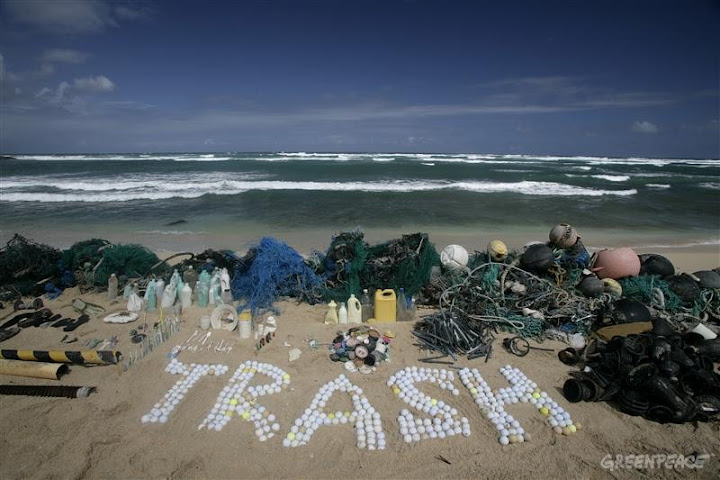
pacific trash vortexPhoto by: Greenpeace.org

pacific garbage patch   pacific garbage patch
Photos by: ProjectRespond.org and Mindfully.org

TAKE THE PLEDGE! Reduce Plastic Waste!


Popular Posts