Showing posts with label gyre. Show all posts

Sunday, April 15, 2012

As Earth Day Approaches Let's Think About The Oceans

Trashing Our Oceans: Great Pacific Garbage Patch
Ian Somerhalder Foundation

Written by: The IS Foundation

There is a growing environmental problem that is notoriously under-reported in the media. Much of the general population is not even aware that a soup of plastic trash exists right now in the North Pacific. This area of the North Pacific is know as the “Great Pacific Garbage Patch”, and is located within the North Pacific Gyre. The area is located between California and Hawaii, and between Hawaii and Japan. There are similar patches of trash in the South Pacific, North Atlantic, South Atlantic, and Indian oceans.

The trash has been traveling to these areas since World War II when people began manufacturing, using, and throwing out plastics on a large scale. Sources of the trash include sea vessels like cruise ships, freighters, and fishing boats. The garbage also comes from shorelines and waterways that feed into the ocean. Although the United States does contribute a big portion of the waste, the ocean currents pick up items from all over the world. Once in the ocean, a piece of garbage travels along the currents until it reaches the gyre. Some of the items wash up on shores around the world leading to trash covered beaches.

READ FULL ARTICLE

Sunday, April 1, 2012

Upcoming Film about the Pacific Garbage Patch!

A sneak peek at the upcoming film by The Surf Lady called "Aqua Seafoam Shame" due to hit the film festivals for 2013. We'd really appreciate it if you could support our project by rating and sharing this video with all your friends on twitter and facebook! Thank you so much for your help in this important cause!!

A CALL TO END PLASTIC POLLUTION


Video by : http://HopeStudios.ca
Music by : http://seasunz-and-jbless.bandcamp.com/track/water-world-2

Sunday, March 11, 2012

Facts About Plastics in the Ocean and What You Need to Know About Them

Addicted to Plastic
  • To date, we use over 248,000 chemicals in commerce and we don't know which ones are harmful or safe. Why? Because the vast amount of research on plastics we use in our lives comes from the plastic industry.
  • Greenpeace estimates that of the 200 billion pounds produced annually, 10% makes it into the ocean.
  • Columbia University Researchers took all the major data sets that exist and calculated 73,878,000 pounds of plastic in the area of the gyres, which accounts for 16 million of the earth's 315 million square kilometers of ocean surface.
  • Americans alone discard 22 billion pounds of plastic a year.
  • To date, 177 species of marine life have been shown to ingest plastics and the number is likely to get much higher as more research is done.
  • 9% of base food chain fish (which represents as much as 50% of the biomass of fish in the entire ocean) sampled in the North Pacific have been shown to ingest plastics.
  • Concentrations of the chemicals in ocean-borne plastics have been shown to be up to a million times higher than the ambient sea water around it.
  • According to the Ocean Conservancy's annual report, 11% of beach litter is plastic bags.
  • Americans consume more than 100 billion plastic bags per year.
  • In 2009, the rate for plastic bag recycling is 6.1%; and in 2010, the rate is 4.3%.
  • From 2009 to 2010, plastics generated in the municipal waste stream jumped from 59,660,000 to 62,080,000 pounds.
  • Coca-Cola is one the world's largest producers of plastic waste.

Quote from Stiv Wilson:
So what's a citizen to do? Unfortunately, cutting through the spin is a difficult task, but as always, when there is a lot of money to be had, injecting oneself with a healthy dose of skepticism about the intentions of chemical companies that manipulate nature for profit is a good start. What's the best solution? Remember this: if you don't consume it in the first place, it can't damage you or the environment.

Avoiding plastics is not just a personal responsibility, it's an environmental mandate and should be as common in our global society as turning off the lights when you leave the room. There is no silver bullet solution to plastic pollution, more like a silver buckshot, but it all starts with you saying two words: "No Plastic."

SOURCE

Watch the Debris from Japan Tsunami Travel Across the North Pacific Gyre


Quote from: NOAAVisualizations
After the earthquake and subsequent tsunami that struck Japan on March 11, 2011, tons of debris was swept into the Pacific. Much of it is buoyant enough to float on the surface and can be moved around by small scale currents and large scale circulation patterns, such as the North Pacific Gyre. The gyre, bounded by the Kuroshio Current on the west, California Current on the east, and Equatorial Current on the south tends to entrain debris in the center of the Pacific basin, creating what is commonly known as the "Great Pacific Garbage Patch." Though the bulk of the marine debris remains in the ocean for years in an area north of Hawaii, individual pieces are continually washing up on the continental and island shores that border the basin. NOAA's Marine Debris Program leads efforts to track and remove much of this existing trash, and is currently assessing the tsunami debris. Scientists as NOAA's Earths System Research Laboratory developed the debris dispersion model, shown here. Using five years of historical weather patterns, the model is used to approximate how debris will circulate across the basin.


Monday, March 5, 2012

ALERT - Tsunami Debris from Japan Headed Towards the Pacific Garbage Patch!


Quote from comlike4:

 The Great Pacific Garbage Patch is expanding. For those who do not know what this is, it is basically comprised of two floating landfills one between Hawaii and California, and the other between Hawaii and Japan. These patches have been growing exponentially, from the first few pieces of fishing nets and plastic bottles discovered 30 years ago, to two patches at least twice the size of Texas (that's a total of over one million square miles of junk). These patches are made up of plastic bottles, furniture, home appliances--pretty much anything you can think of, though 90% of the trash is plastic.


Quote from mallugirls15:

The Fukushima power plant meltdown isn't the only environmental problem created by the Japan tsunami. Refrigerators, TVs, rooftops and other items that the tsunami swept away last year are now floating in the Pacific Ocean, the Washington Post reported. Officials expect the debris to get caught in the Great Pacific Garbage Patch.

The tsunami, which killed 15,844 people and left over 3,000 missing, also washed out 8 million tons of debris to the sea. Most of the debris sank near the shore, the Los Angeles Times reported. But the debris that didn't sink has since traveled 3,000 miles away.


Saturday, February 4, 2012

Plastic Garbage Patch in the Pacific Ocean

We're on a mission to document the Pacific Trash Vortex (aka "Plastic Island") and to find alternative plastics that can biodegrade back into the earth, such as Hemp Bioplastics. We need your help in raising awareness of this environmental disaster that affects every living creature on the planet. We encourage EVERYONE to take the pledge of "raising awareness" of this very important environmental issue. Blog about the Pacific Trash Vortex (using specific keywords and tags). Record your own video about the Pacific Garbage Patch, upload it to youtube, vimeo etc. and share it with everyone on your friends lists. Think Global Act Local: We can also find alternative ways to reduce, reuse, and recycle the plastic waste in our everyday lives so it doesn't end up in the Pacific Ocean. Join us and make the PLEDGE OF ACTION now! Learn more.


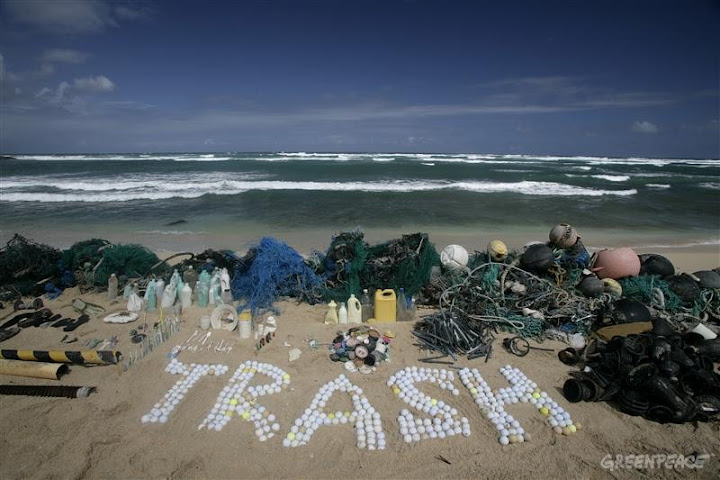
pacific trash vortexPhoto by: Greenpeace.org

pacific garbage patch   pacific garbage patch
Photos by: ProjectRespond.org and Mindfully.org

TAKE THE PLEDGE! Reduce Plastic Waste!


Popular Posts